The Leadership Layer
Every railroad starts with someone deciding where the trains should go — and making sure there’s money to build the track.
The Railroad Company is the railroad itself. They decide which routes get funded, which lines get built, and what the network needs to achieve. They don't drive the trains, but nothing moves without their investment and direction.
The COO sets the business goals and controls the budget for the digital product team. They define what needs to be built and why it matters to the organization — but they're not in the day-to-day. They set the direction; the crew figures out how to get there.


The Route Planner decides where the train goes and why. They study where passengers need to travel, which destinations are underserved, and what new routes would create the most value. They set the destination — but they're not part of the crew making it happen.
The Product Leader owns the business vision for their product line. They know where the business is going and what their users need to get there. They translate company strategy into product direction — and they're the ones making the case to the COO for what gets built next.
The Station Master is accountable for the train actually arriving. They coordinate the operational plan and make sure the right crew is assembled and equipped. When the Route Planner says "we need a line to Chicago," the Station Master figures out how to make that happen — on schedule and on budget.
On a digital product team, the Application Owner bridges business intent and technical delivery. They weigh every request against available resources, manage competing priorities, and are ultimately accountable for whether the product ships — and whether it works when it does.

The Operating Crew

The Cartographer surveys the territory before the track gets laid. They talk to the towns along the route — what do people need to ship, how many passengers are expected, and what are the terrain constraints? Then they turn all of that into detailed maps and specifications that the crew can build from. Every bridge width, every platform height, every siding — the Cartographer documented it before anyone picked up a hammer.
On a digital product team, the Business Analyst is the one who does the discovery work before a single line of code gets written. They interview stakeholders, document requirements, map existing systems, and define constraints. They're the reason the rest of the crew isn't building on assumptions.
The Conductor is on the train, walking the cars, making decisions in real time. Which passengers board first? What's the stop order? They manage the manifest — the backlog — call out the next station, and make constant judgment calls about what happens now versus later.
On a digital product team, the Product Owner keeps the work moving. They prioritize the backlog, define what gets built in each sprint, and make daily decisions that balance user needs, business goals, and technical realities. They're the connective link between the vision upstairs and the crew doing the work.

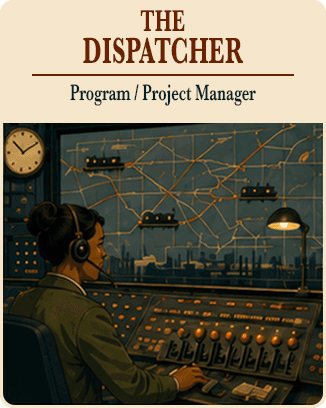
The Dispatcher watches the entire network from the control tower. They track each train's location, spot conflicts before they become collisions, and keep the schedule honest across multiple lines. When one train is delayed, the Dispatcher reroutes others so the whole system doesn't break down.
On a digital product team, the Project Manager holds the schedule together. They track deliverables across every workstream, surface dependencies before they become blockers, and make sure the right people have the right information at the right time. Without them, the crew is talented but uncoordinated.
The Engineer has their hands on the throttle. They know the engine, they know the terrain, and they make the technical calls about speed, braking, and which track to take when there's a fork. They translate the route into motion.
On a digital product team, the Tech Lead sets the technical direction. They make the architectural decisions, establish coding standards, and guide the development team through complex problems. They're the ones who know what's possible, what's risky, and what will cause problems three sprints from now if nobody addresses it today.


The Architect is the hub of the operation. They sit with the Route Planner to understand the destination, work with the Conductor to set priorities, and walk the tracks with the Rail Workers to understand what's buildable. Then they ride the train with the Travelers to understand what the journey actually feels like.
They translate between everyone — turning business goals into spatial designs, engineering constraints into passenger comfort, and traveler frustrations into blueprints the crew can act on. They design the cars, the layout, the signage, the flow from platform to seat — not just how it looks, but how it flows.
On a digital product team, UX is the role that holds the human experience at the center of every decision. A UX Designer doesn't just make things look good — they research, define, prototype, test, and iterate. They advocate for the user in rooms where business and technology are the loudest voices. And they speak enough of everyone's language to translate between all of them.
The Rail Workers lay the track and build the cars. They're the ones doing the physical work of construction — and their craftsmanship determines whether the ride is smooth or rattling. A good rail crew also flags problems they can see from ground level that nobody in the tower noticed.
On a digital product team, Developers write the code that makes the product real. They turn designs and requirements into working software — and the best ones don't just execute, they suggest better approaches, and catch things before they become problems.


The Safety Inspector walks the train before it leaves the station and checks every coupling, every brake line, every door latch. They don't just confirm the train moves — they confirm it's safe to move. They're the ones who'll hold departure if something isn't right to keep everyone safe.
On a digital product team, QA tests the product for everything it's supposed to do — and a few things nobody thought to document. They find the edge cases, the broken flows, the things that work on one device and fail on another. They're the last line of defense between the team and the user, and a good QA engineer makes the whole product better.
Travelers
The Travelers are the whole reason the railroad exists.

